

CompuLab Puts NXP's i.MX952 on a Nine-Gram Module
The UCM-iMX952 pairs Cortex-A55 application cores with M7 and M33 real-time cores in 28 by 40 by 5 mm, across commercial, extended and industrial temperature grades.
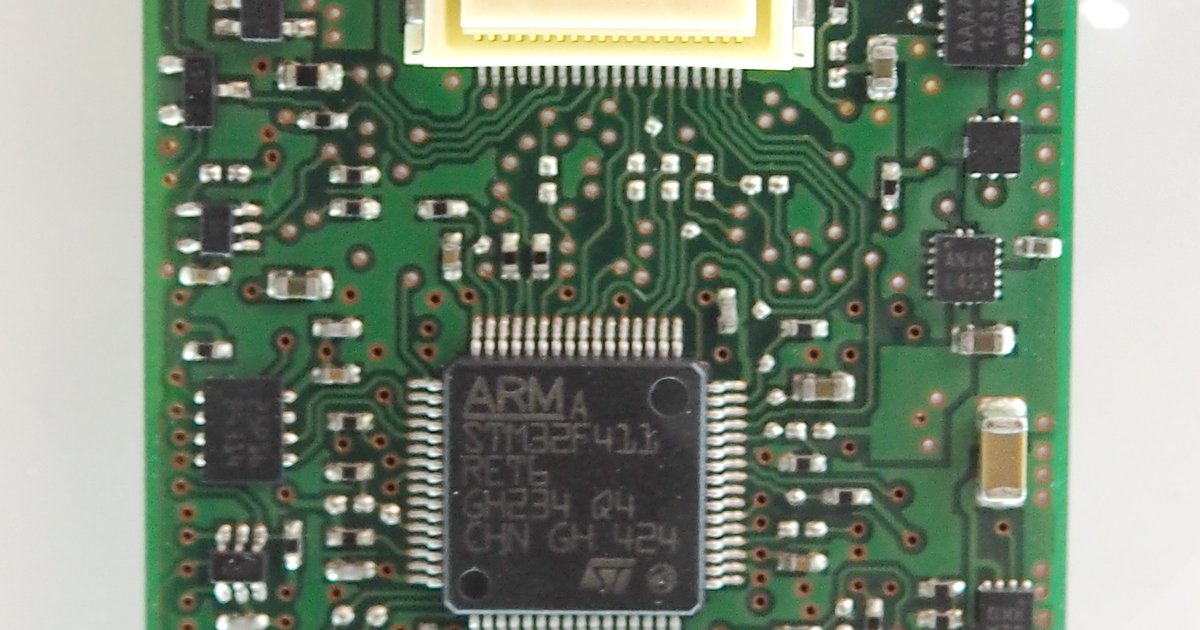
CompuLab launched the UCM-iMX952 on 17 September, a system-on-module built on NXP's i.MX952 and measuring 28 by 40 by 5 mm at 9 grams.
The processor arrangement is the interesting part: dual- or quad-core Arm Cortex-A55 at up to 1.7 GHz for the Linux side, plus Cortex-M7 and Cortex-M33 cores providing a deterministic control island on the same part. Memory runs 4 to 16 GB of LPDDR5 or LPDDR4X, storage 16 to 128 GB of eMMC. Connectivity is 2.5GbE and Wi-Fi 6, with PCIe Gen 3, MIPI-DSI, MIPI-CSI and dual LVDS for expansion and display. Temperature grades are commercial at 0 to 70 C, extended at -20 to 70 C and industrial at -40 to 85 C. An evaluation kit is listed as coming soon, from $645.
That combination — Linux for the interface and networking, M-cores for the loop, on one module rated to 85 degrees — is the standard recipe for a machine controller that has to render a GUI and close a control loop without two processors and a communication bus between them.
The timing matters as much as the specification. The i.MX8M generation that sits inside a great deal of fielded industrial equipment is reaching end-of-life, and every product built on it faces a redesign. The i.MX952 is what NXP expects those designs to move to, and a drop-in module in three temperature grades is how most OEMs will actually make the transition — swapping the module rather than respinning the carrier.
One caveat worth checking early: the M-core toolchain and the Linux BSP come from different parts of NXP's software stack, and how cleanly they share memory and interrupts on a new generation is rarely obvious from a datasheet. Teams that have done this before tend to prototype that boundary first.