

What a Vibration Sensor Can and Cannot Tell You
Vibration monitoring finds bearing faults, imbalance and misalignment well. It finds many other things badly. Knowing which is which decides whether the programme survives its first year.
Vibration is the most productive condition-monitoring measurement on rotating equipment, and it is also the one most often sold as though it detects everything. It does not. It detects a specific and well-understood family of mechanical faults extremely well, detects a second family only under conditions that are frequently absent, and says nothing useful about a third. A programme that knows the boundary succeeds; one that promises across the boundary gets cancelled after the first missed failure.
What it does well begins with imbalance, which appears as a strong component at exactly one times running speed, largely radial, and stable in phase. Misalignment produces one and two times running speed with a characteristic axial component. Looseness produces a series of harmonics. Bent shafts, belt problems and blade-pass or vane-pass phenomena all have signatures that follow directly from geometry and speed. These are the cases where vibration is not just indicative but diagnostic: the spectrum tells you which fault, not merely that something is wrong.
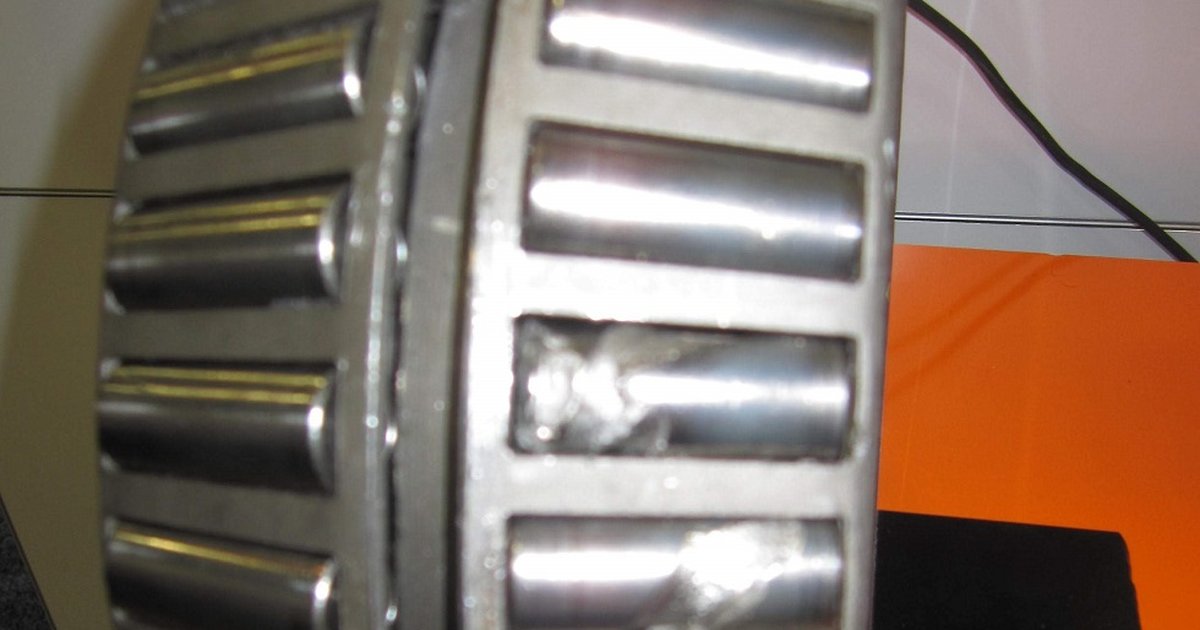
Rolling-element bearing defects are the second strong case, and the most valuable, because they give long warning. A spall on a race or a rolling element generates a repeating impact at a frequency set by the geometry — the ball pass frequencies and the cage and ball spin frequencies, all computable from the bearing's dimensions and the shaft speed. The catch is that these impacts are small and high-frequency, and in the raw spectrum they are buried under the much larger low-frequency energy. This is why envelope or demodulation analysis exists: band-pass the signal high, rectify it, and look at the spectrum of the envelope, where the impact repetition rate appears cleanly. Doing this well requires knowing the bearing part number and the running speed. A programme that has neither is looking at overall levels, which is a far weaker instrument.
Gearboxes are where it gets harder. The signatures are real — gear mesh frequency and sidebands spaced at shaft speed — but the spectrum is crowded, the energy from a single cracked tooth is small relative to mesh energy, and the useful indicators often need time-synchronous averaging, which needs a tachometer reference. Gearbox monitoring is legitimate and valuable, and it is not the same difficulty class as a pump bearing.
Now the limits. Low-speed machinery is genuinely hard: below roughly one hundred revolutions per minute the energy from a bearing defect approaches the noise floor of a standard accelerometer, and the honest tools are acoustic emission, ultrasound, or a low-frequency accelerometer chosen specifically for the job — not the same sensor used on the fan. Variable-speed machines break the assumption that a spectral line sits at a fixed frequency; without order tracking against a speed signal, the spectrum smears and the diagnosis disappears. Load variation does the same thing to amplitude trends, which is why a rising trend on a machine whose duty changed is very often not a fault at all.
There are also faults vibration simply does not see. Electrical faults in motors — rotor bar and winding problems — sometimes leave a vibration trace but are better found with current signature analysis. Lubrication starvation shows up late and ambiguously. Internal erosion, fouling and blockage in pumps and heat exchangers are process problems that pressure, flow and temperature detect first. Cavitation produces broadband noise that is recognisable but easily confused with other broadband sources.
The practical consequences are mostly about installation, and they are where most programmes actually lose. Mounting dominates everything: a stud-mounted accelerometer is usable to many kilohertz, a magnet mount considerably less, and a handheld probe barely into the range where bearing faults live — so a magnet mount can make bearing diagnosis impossible while still producing a plausible-looking number. The measurement point must be on the load path, close to the bearing housing, on metal, in the same place every time; moving the sensor fifteen centimetres changes the spectrum enough to invalidate the trend. And the first measurement's value is zero, because almost everything in vibration analysis is comparative — against a baseline on that machine, against an identical machine, or against a trend. A programme that starts by collecting a good baseline set while the equipment is known-healthy is doing the highest-value work it will ever do.
Set expectations accordingly. Vibration will give weeks to months of warning on bearing degradation on constant-speed machinery that is properly instrumented. It will not tell you the remaining useful life in days, whatever the dashboard implies. And it is at its best not as an alarm but as an input to a decision that somebody has to make anyway: whether to open this machine at the shutdown that is already scheduled.